
How Cal State Fullerton Ran a 7-Category Engineering Expo on AwardKit
66 senior projects, 31 judges, and 7 categories judged in a single morning. How CSUF switched judging platforms for live results on AwardKit.
ECS Student Project Innovation Expo 2026
Titan Student Union, Cal State Fullerton, CA
Sponsors
66
Entries
31
Judges
7
Categories
12
Awards
An Innovation Expo: Engineering in Full Display
Every spring, the College of Engineering and Computer Science at California State University, Fullerton turns the Titan Student Union Pavilions into a working showcase of senior capstone projects. The ECS Student Project Innovation Expo is the culmination of months of undergraduate research projects across four departments, judged in person by faculty and industry professionals on a single Friday morning.
This year, on May 1, 66 finalist teams advanced from a preliminary abstract round to present their projects live. 31 judges evaluated them across 7 competition categories: Mechanical Engineering, Electrical and Computer Engineering, Civil and Environmental Engineering, Computer Science, Corporate-Sponsored Projects, Legacy Projects, and an overall Grand Prize that every team competed for.
The judging panel pulled from across industry and the CSUF faculty: engineers and leaders from Edwards Lifesciences, Boeing, NASA JPL, Apple, Raytheon, Anduril, Rivian, IBM, Medtronic, Disneyland, 1Password, Edison International, and Fluor, alongside eight CSUF faculty judges spanning every department in the college.
Projects ranged from a hybrid hydrogen fuel cell drone and an autonomous vehicle built for Raytheon, to a heart valve testing rig sponsored by Edwards Lifesciences, a roller coaster brake tester for Disneyland, a steel pedestrian bridge, and a machine-learning streaming protocol. Four engineering disciplines, one expo floor, judged in two hours.
Why CSUF Switched Platforms
ECS Expo isn't new. The college has run it for years, and they've used an external judging platform before. But last year, the experience with the previous judging platform had its rough edges.
Setup took weeks. The previous platform couldn't show scores the way the committee needed them for deliberation, so when judging closed, organizers exported everything to CSV, sorted it in a spreadsheet, and pieced together the rankings by department by hand. With 60+ projects, weighted criteria, and an awards ceremony that same afternoon, the manual work added real pressure to an already tight timeline.
For an annual program with industry sponsors in the room and a same-day awards ceremony, re-importing data into a spreadsheet wasn't going to scale. So this year, the organizers moved to AwardKit, a modern judging platform built for multi-category scoring and weighted rubrics.
"Last year, the moment judging closed, we were exporting CSVs and rebuilding rankings in a spreadsheet just to start deliberating. This year, we walked into deliberation with every ranking already weighted and sorted."
- Dr. Ankita Mohapatra, ECS Innovation Expo Organizer, Cal State Fullerton
Seven Categories, One Rubric, Custom Judge Assignments
The expo judging structure is more complex than a typical competition. Every project competes for the Grand Prize, and each one also competes in its own departmental category. A Mechanical Engineering project competes against the other 7 mechanical projects for Best in Department, and against the full field of 66 for Overall Best. Corporate-Sponsored projects compete in their own category alongside the four academic departments and the Legacy category.
In AwardKit, that maps cleanly:
- 7 categories running in parallel on the same entry pool
- 66 projects entered into the Grand Prize, plus the relevant departmental category (and the Corporate-Sponsored category for the 15 industry-backed projects)
- 31 judges assigned manually to specific categories based on their department and expertise
Custom judge assignment matters here. Faculty in Mechanical Engineering judge the mechanical projects. Industry judges from sponsor companies score the Corporate-Sponsored category. When a judge opens their link, they see only the projects they've been assigned to, scored against the criteria that apply to that category.
The Rubric, Weighted
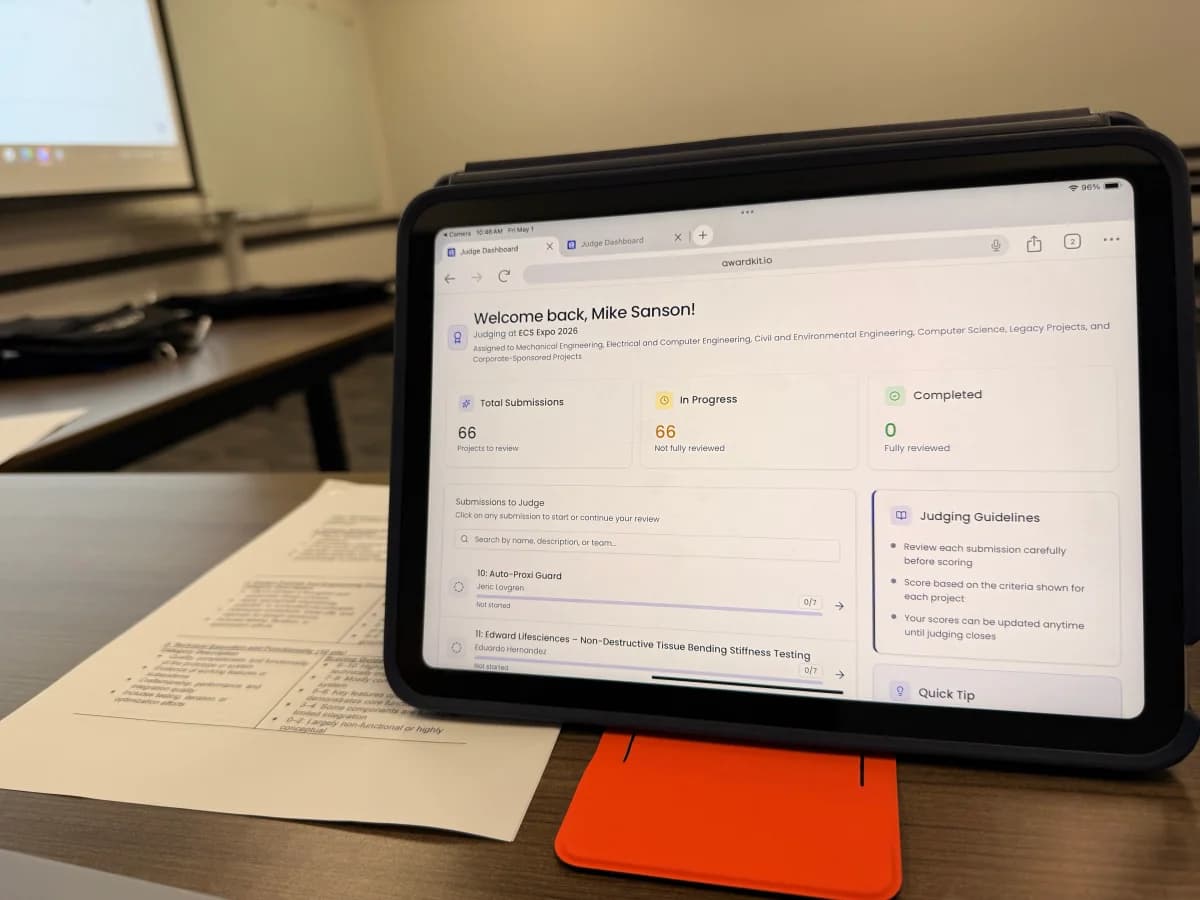
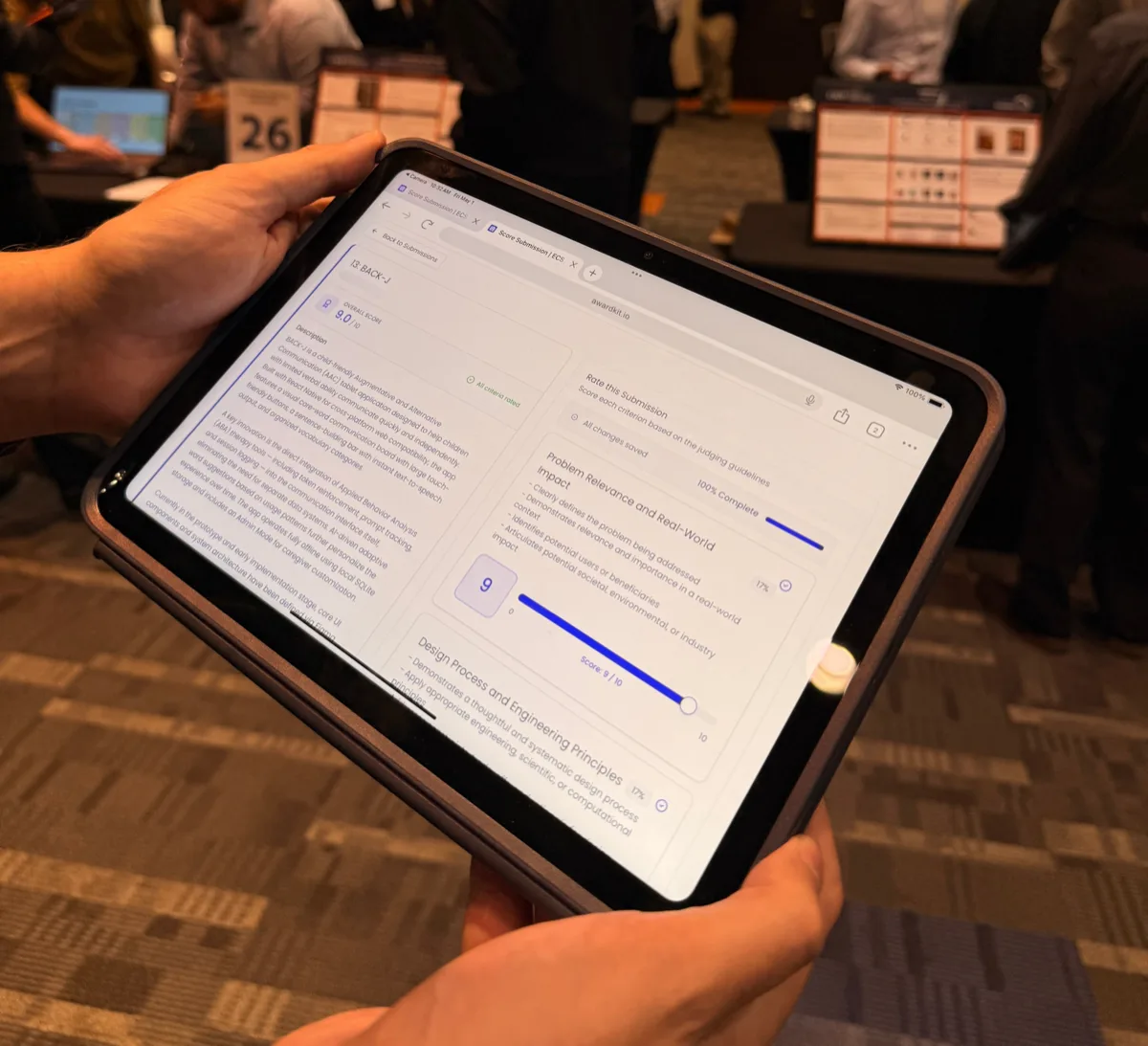
ECS Expo uses a published rubric with five core criteria and two bonus criteria, with the bonus criteria weighted differently from the core ones. It's a complicated rubric on paper, the kind that usually means error-prone hand-weighting in a spreadsheet. In AwardKit, judges just moved a slider for each criterion on a 0-10 scale. AwardKit scaled and averaged those scores into a single cohesive score per project automatically, with bonus criteria contributing half as much to the final score as core criteria.
Core criteria:
- Problem Relevance and Real-World Impact
- Design Process and Engineering Principles
- Technical Execution and Functionality
- Presentation and Communication
- Project Innovation and Originality
Bonus criteria:
- Teamwork, Passion, and Professionalism
- Sustainability and Societal Responsibility
AwardKit aggregated each criterion automatically and rolled the totals into a single ranked result per category. It also kept every criterion visible on its own, so the committee could rank projects by a single criterion instead of the overall score when needed. That's how awards like Most Innovative Project of the Year and Best Sustainability-Focused Project were decided: by sorting on the Innovation and Sustainability criteria directly. Judges scored what was in front of them. The math happened on its own.
Two Hours on the Expo Floor
The day ran on a tight schedule. Students set up posters and prototypes from 7 AM. Judges previewed projects from 8 to 9 AM without students present. From 9 to 11 AM, judges walked the floor, with at least three judges visiting each team for a focused 10-minute conversation about the project, its design process, and its results.
With 31 judges on the floor and one iPad per judge, getting everyone logged in and pointed at the right projects has historically been the rough edge of the morning. The previous platform required a unique login account per judge, which forced organizers to buy a custom domain and generate email aliases for every judge just to onboard them onto iPads. This year, with AwardKit, each judge had a unique QR-code link tied to their assignment. Scan and start scoring. When judges swapped in or out in the days and hours before the event, organizers reassigned them in AwardKit in seconds.
Throughout the morning, Dr. Ankita Mohapatra, the expo organizer, had a live view of each judge's progress: who had started, who was on track, who needed to speed up. With 31 judges working in parallel, that live visibility meant any slowdowns could be caught and addressed early. On the previous platform, getting the same visibility meant exporting a CSV and sorting through it by hand, by which point the moment to act would have already passed.
By the time judging wrapped, 31 judges had cast 309 scoring sessions across 66 projects, producing 2,163 individual criterion scores. Every score was already in the system.
"Last year, we had to buy a custom domain and create email aliases for every judge just to get them onto iPads. This year it was one QR code per iPad, no email necessary for the judges, and last-minute swaps just worked."
- Dr. Ankita Mohapatra, ECS Innovation Expo Organizer, Cal State Fullerton
Live Results, By Category
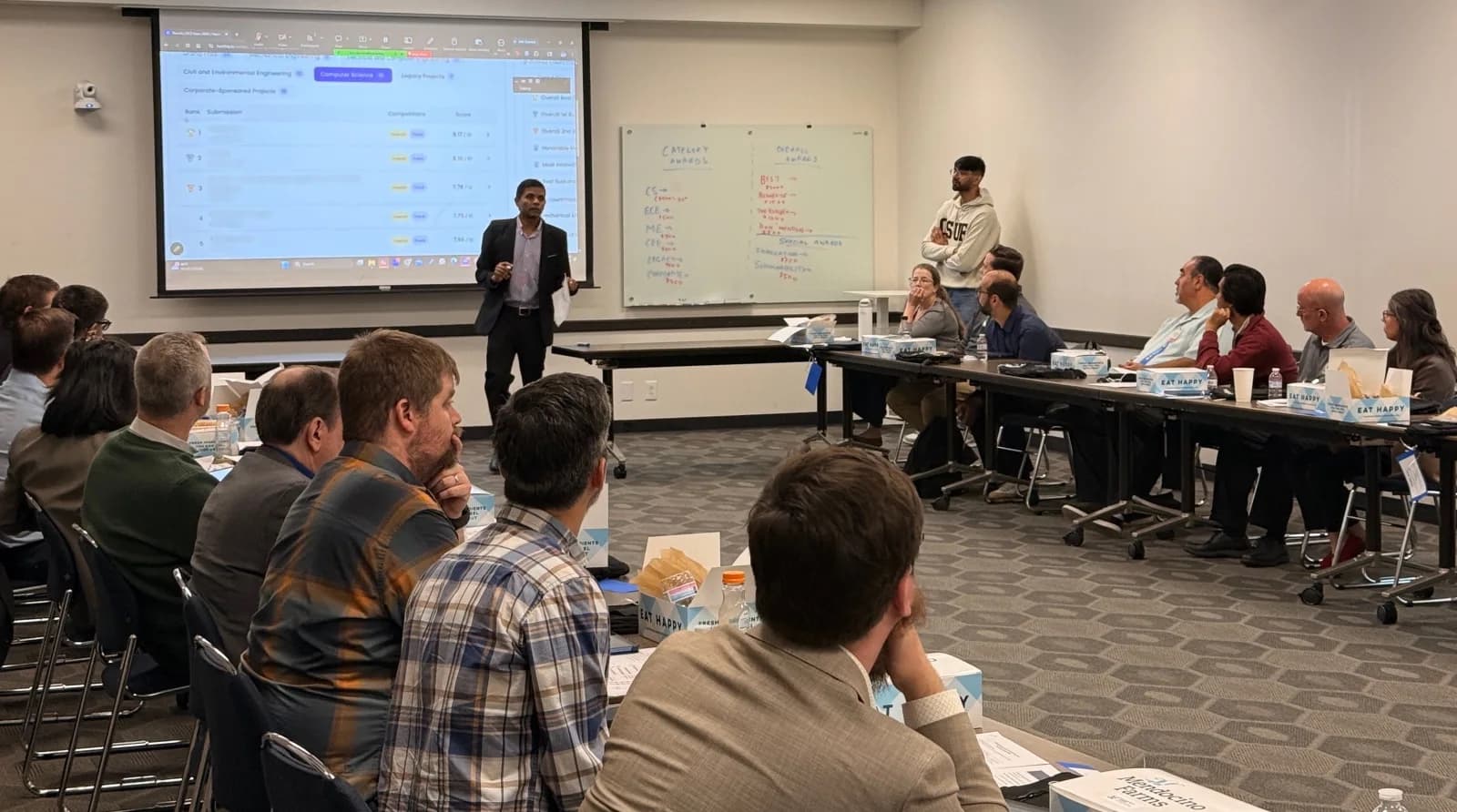
Between 11 AM and 1:15 PM, the committee deliberated. With 31 judges spread across the floor (up from 23 last year) and no single judge having seen every project, deliberation is where the actual decisions get made: cross-referencing scores, debating ties, confirming winners across categories. On AwardKit, everything the committee needed was already on screen: criterion-level scores per project, overall and per-category rankings, and which projects had already won in another category. As the committee locked in decisions, each team could be tagged as a winner in a category, and that tag stayed visible against every other ranking. That made it easy to deliberately spread the awards across teams instead of manually keeping track of who had already won what. Last year, this same window started with a CSV export and weighting the scores by hand before deliberation could even begin.
When the awards ceremony started at 1:15 PM, the committee had chosen winners for every category:
- Overall Best Project: RTX Autonomous Vehicle Competition Project
- Overall 1st Runner-Up: Titan Green Hydrogen Drone
- Overall 2nd Runner-Up: SpeakSight
- Honorable Mention: GeoCORK
- Most Innovative Project of the Year: BACK-J
- Best Sustainability-Focused Project: Arboretum Debris Filtration and Removal, and Smart Monitoring of Portland Limestone (tied)
- Best Project in Mechanical Engineering: CSUF Machine Shop Waterjet Maintenance Tool
- Best Project in Electrical and Computer Engineering: Quadconn
- Best Project in Civil Engineering: Project Haven Flow
- Best Project in Computer Science: Machine Learning Enhanced Streaming Communication
- Best Corporate-Sponsored Team: Operational Technology Security Assessment
- Best Legacy Project: Titan Rover
12 awards across 7 categories, $9,500 in total prize money, all calculated and ready before the ceremony started.
For an annual academic program with industry sponsors, faculty advisors, and a published rubric, there's no margin for a judging platform that needs workarounds. This year, AwardKit handled the setup, the judging, and the results, with every score and per-category ranking on screen for the committee to deliberate. The organizing team spent the day with the students and the judges they had brought to campus.
"If you're running an engineering expo or student showcase, this is what you want: a smooth and reliable judging process. I wish we'd had something like AwardKit last year. I'm going to recommend this platform to other similar programs."
- Dr. Ankita Mohapatra, ECS Innovation Expo Organizer, Cal State Fullerton
By the Numbers
- 66 finalist projects across 4 engineering departments, all entered into the Grand Prize and their respective departmental categories
- 31 judges, all of them voted, assigned manually to the categories that matched their expertise
- 2,163 individual criterion scores captured across the morning, weighted and aggregated automatically
- 2-hour judging window from 9 to 11 AM, with judges spending roughly 10 minutes per team
- No CSV exports required to determine winners
About ECS Expo
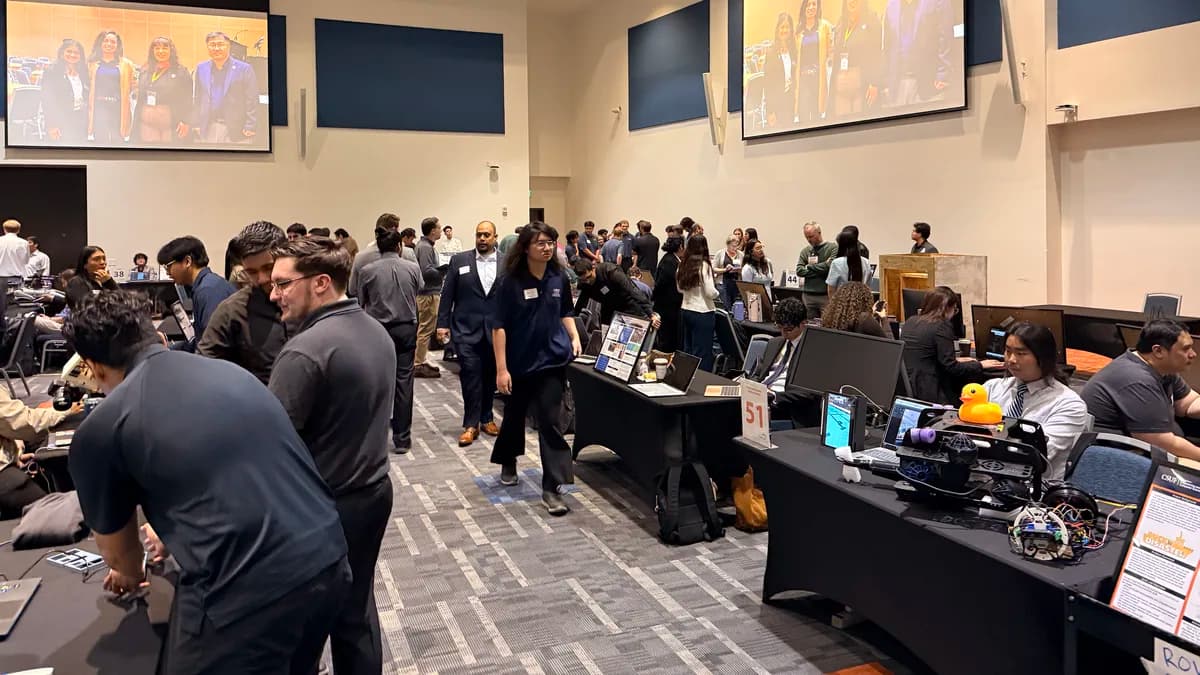
The ECS Student Project Innovation Expo is an annual showcase organized by the College of Engineering and Computer Science at California State University, Fullerton. It is open to ECS undergraduate students across four departments, with finalist teams selected from a preliminary abstract round and presenting in person at the CSUF Titan Student Union. The 2026 edition was held on May 1 and used AwardKit for entries, judging, and results.
Ready to run your award program with AwardKit?
Join organizations that focus on their programs, not their tools.
Build for free • First-cycle guarantee when you go live